True Thermodynamic Chilled Mirror Hygrometry
A chilled mirror hygrometer is fundamentally a thermodynamic instrument.
The Reshining RDP architecture is designed to preserve that thermodynamic integrity while improving stabilization dynamics.
Chilled mirror hygrometry represents the primary-standard method for direct thermodynamic dew and frost point measurement.
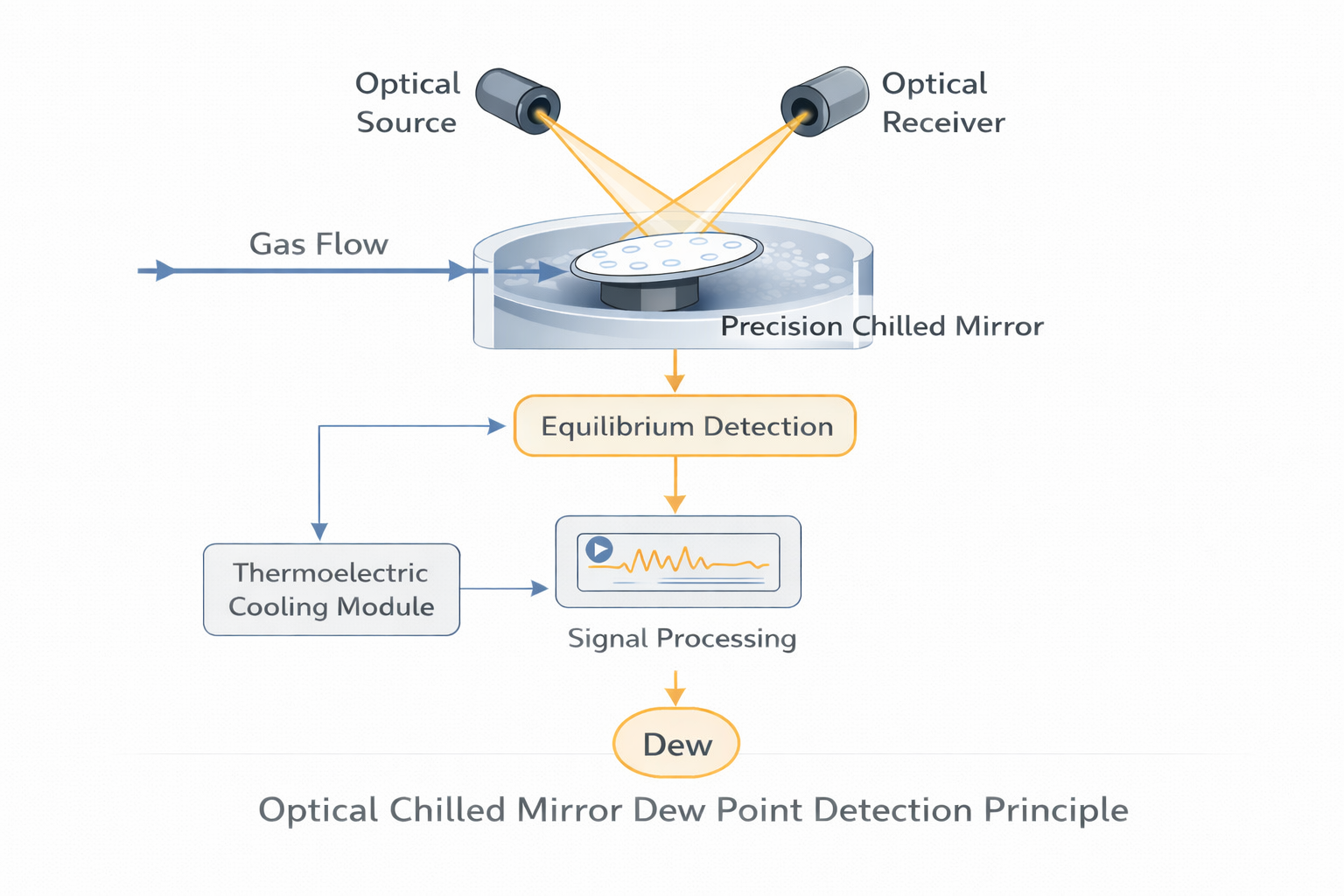
Unlike indirect humidity sensors that estimate dew point through humidity models, chilled mirror instruments determine the dew point by observing the actual thermodynamic equilibrium between condensation and evaporation on a precision mirror surface.
The RESHINING RDP series combines this fundamental measurement principle with advanced adaptive control technology to achieve high accuracy, excellent repeatability, and long-term measurement stability across laboratory and critical industrial environments.
Direct Condensation Equilibrium Detection
The RDP system cools a precision mirror surface until condensation begins to form.
An optical detection system continuously monitors the mirror condition and identifies the equilibrium point between condensation and evaporation.
At this equilibrium state, the mirror temperature directly corresponds to the true thermodynamic dew or frost point temperature.
This direct equilibrium detection method eliminates many sources of uncertainty associated with indirect humidity measurement techniques and provides highly reliable reference-grade humidity measurements.
Adaptive Dew Point Control Architecture
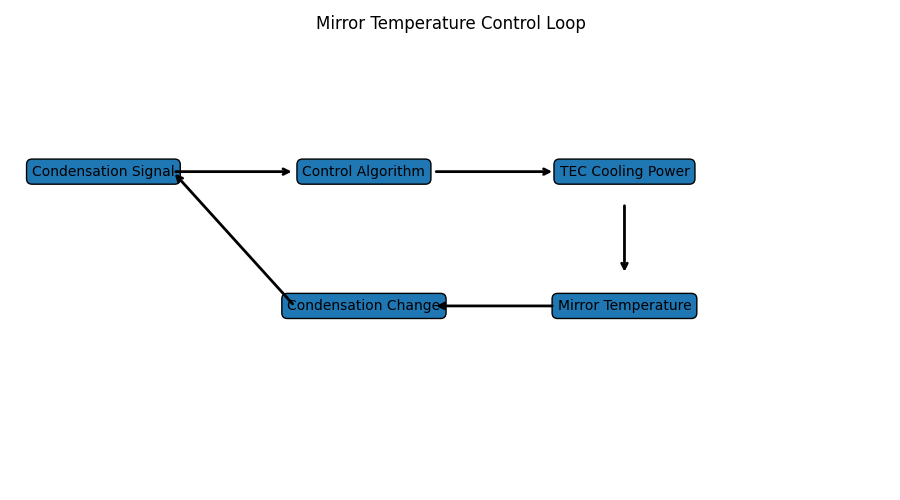
The RDP series incorporates an adaptive optical feedback control architecture designed for fast and stable dew point equilibrium detection.
The system continuously analyzes the optical signal from the mirror surface and dynamically adjusts the thermoelectric cooling power to maintain equilibrium conditions.
Key elements include:
• Optical condensation monitoring
• Adaptive control algorithm
• Thermoelectric cooling regulation
• Precision mirror temperature control
This architecture enables fast convergence toward the equilibrium dew point while maintaining excellent measurement stability.
Dynamic Stabilization Control Architecture
The stabilization process is engineered to achieve controlled convergence toward thermodynamic equilibrium.
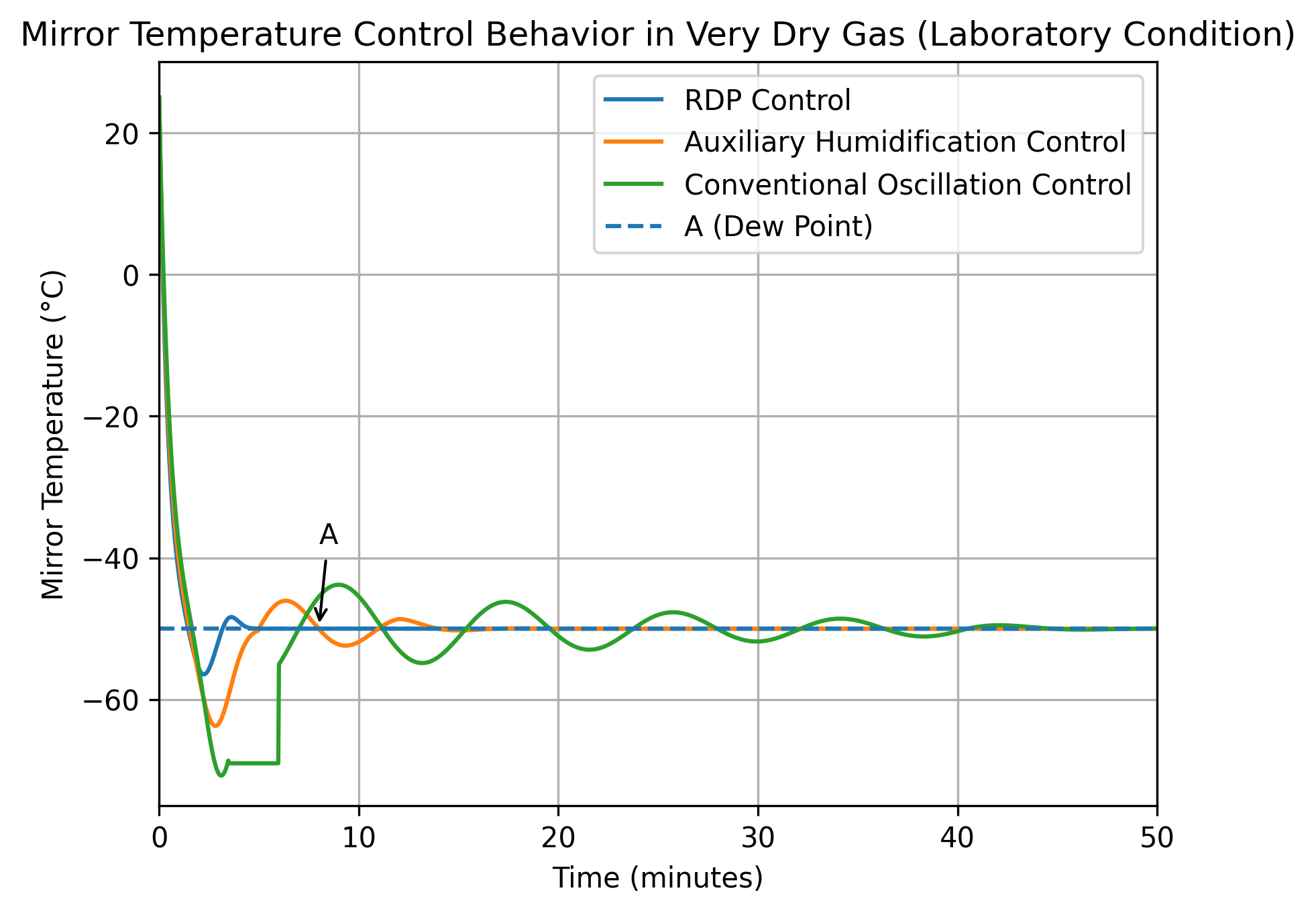
Rather than prioritizing aggressive temperature transitions, the RDP system ensures smooth equilibrium convergence with minimized overshoot behavior.
This dynamic stabilization strategy significantly reduces oscillation and allows the mirror temperature to stabilize quickly near the dew point.
Controlled Convergence with Reduced Overshoot
Optimized closed-loop control minimizes overshoot amplitude and correction oscillations around the equilibrium point.
This contributes to:
• Improved repeatability
• Stable convergence behavior
• Reduced thermal cycling
• Enhanced long-term measurement stability
Differential Feedback Stabilization
The RDP control architecture incorporates differential feedback detection to enhance sensitivity to dynamic mirror surface state changes.
By responding to the rate of change in condensation conditions, the system achieves highly precise equilibrium control and stable thermodynamic detection.
Dew Point Measurement Stability
Adaptive optical feedback control maintains a highly stable mirror temperature during equilibrium detection.
This stability enables precise dew point measurements with minimal fluctuation and excellent repeatability over time.
Gas-Specific Optimization for Nitrogen and SF₆ Systems
Chilled mirror dew point measurement behaves differently depending on the thermodynamic properties of the process gas.
In nitrogen environments, condensation may initially appear as supercooled water droplets before reaching stable equilibrium on the mirror surface.
The control algorithm manages this transient condition to ensure stable condensation detection without introducing oscillation or excessive cooling.
In SF₆ gas systems, the measurement process must also consider the phase transition characteristics of sulfur hexafluoride.
Excessive cooling may approach the liquid or solid phase region of SF₆, which can interfere with stable dew point equilibrium.
The Reshining control architecture incorporates gas-specific cooling strategies that guide the mirror temperature smoothly toward condensation equilibrium while avoiding unnecessary deep cooling.
This approach enables reliable moisture measurement in both high-purity nitrogen systems and SF₆ gas-insulated high-voltage equipment.
Engineering Philosophy
Engineered for thermodynamic integrity.
Designed for stability.
Built for accuracy.
The RESHINING RDP series prioritizes controlled stabilization and equilibrium integrity to deliver consistent thermodynamic performance for high-accuracy humidity measurement applications worldwide.