Dynamic Stabilization of Chilled Mirror Dew Point Hygrometers in Ultra-Dry Gas Conditions
Xiao Zhang
Reshining Instruments LLC, Texas, USA
Technical Illustrations: Harry Zhang
Abstract
Chilled mirror hygrometers are widely recognized as primary instruments for accurate dew point and frost point measurements because they are based on direct thermodynamic equilibrium on a cooled mirror surface. However, when measuring extremely low moisture concentrations in gases such as nitrogen, argon, or other ultra-dry industrial gases, stabilization of the mirror temperature becomes increasingly difficult because condensation kinetics become very slow.
Traditional oscillation-based control strategies establish condensation equilibrium by repeatedly overcooling and reheating the mirror surface. Under ultra-dry conditions, this process can lead to prolonged stabilization time and repeated temperature oscillations around the true dew point.
Some instruments employ auxiliary humidification techniques to accelerate condensation formation. While this approach may shorten stabilization time in certain cases, it introduces additional uncertainty sources including humidification trigger selection and variability of the moisture reservoir.
This technical note analyzes stabilization dynamics in chilled mirror hygrometers during ultra-dry gas measurements and discusses a dynamic stabilization control strategy that enables smooth convergence toward thermodynamic equilibrium without external humidification.
Keywords
Chilled mirror hygrometer; dew point measurement; frost point measurement; ultra-dry gas; condensation equilibrium; humidity metrology.
1 Introduction
Accurate measurement of dew point or frost point temperature plays an essential role in many industrial and scientific applications including high-purity gas production, electrical insulation systems, gas quality monitoring, and humidity metrology laboratories. Among the available techniques, chilled mirror hygrometers are widely regarded as primary instruments for precise dew point determination because they determine the thermodynamic equilibrium between condensation and evaporation directly on a cooled mirror surface [1–3].
In a chilled mirror hygrometer, a reflective mirror is cooled until condensation forms. At equilibrium, the rate of condensation equals the rate of evaporation, and the mirror temperature corresponds to the dew point or frost point temperature of the gas [1,2]. Because of this direct equilibrium measurement principle, chilled mirror hygrometers are commonly used as reference instruments in calibration laboratories.
However, when measuring extremely dry gases such as high-purity nitrogen or argon, stabilization behavior becomes significantly more complex. Under these conditions, the number of water molecules available for condensation is extremely small, and the formation of a stable condensation layer on the mirror surface may require extended time.
Traditional chilled mirror control strategies often rely on oscillatory mirror temperature regulation to establish condensation equilibrium. While effective under moderate humidity conditions, this approach may lead to long stabilization periods and significant oscillation amplitude in ultra-dry gas measurements.
To accelerate condensation formation, some chilled mirror instruments introduce auxiliary humidification techniques. Although this approach can shorten stabilization time, it may also introduce additional uncertainty sources related to humidification trigger selection and moisture reservoir variability.
The present technical note summarizes engineering observations related to stabilization dynamics in chilled mirror dew point measurements under ultra-dry gas condition
Figure 1.
2 Condensation Dynamics in Ultra-Dry Gas
In ultra-dry gases the condensation process becomes significantly slower because the concentration of water molecules is extremely low. The thermodynamic relationships between vapor pressure, frost point temperature, and dew point temperature have been extensively studied in humidity metrology literature [1–4].
Supercooled Condensation Behavior
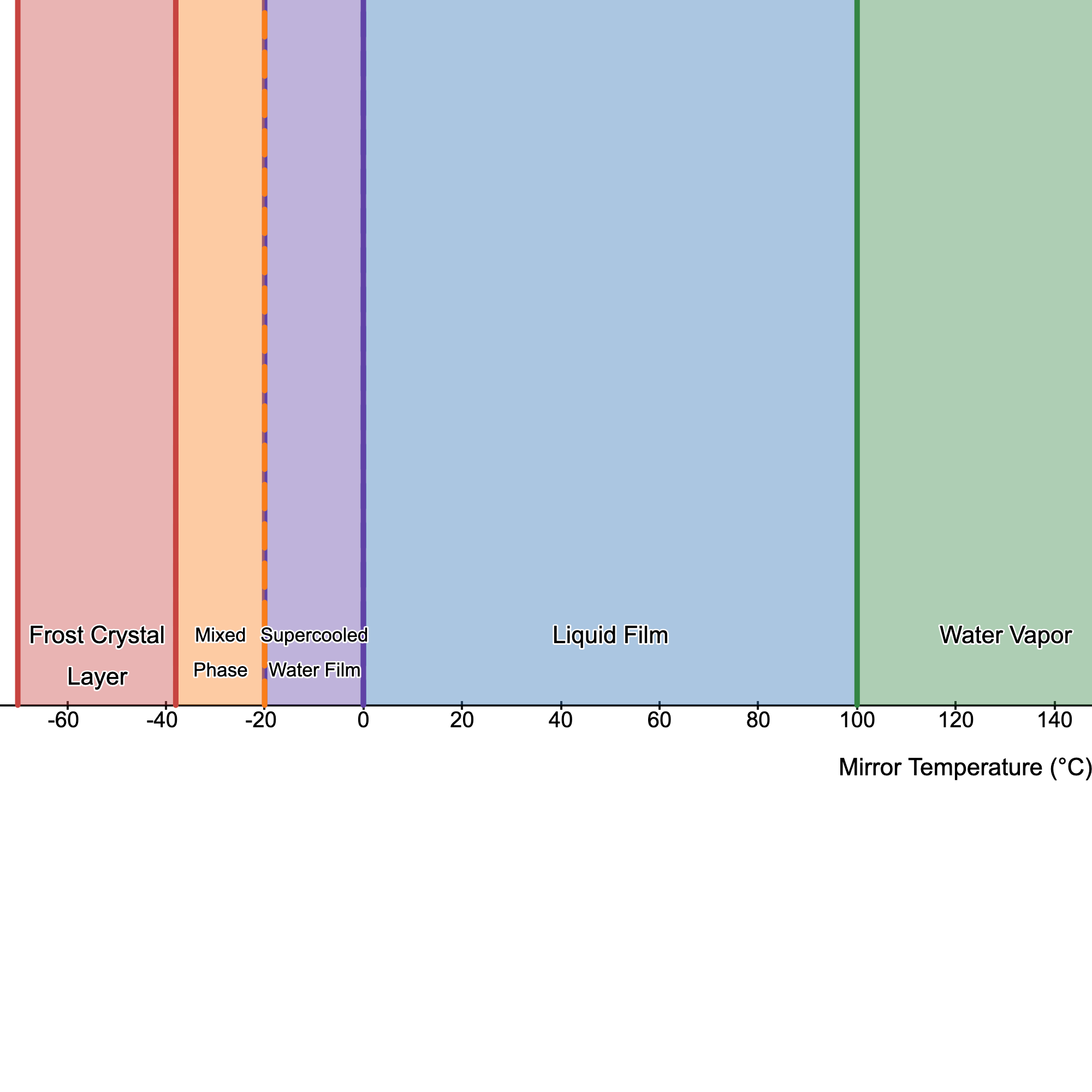
In ultra-dry gas measurements, the condensation process on the mirror surface may initially occur in the form of supercooled liquid water, particularly when the mirror temperature falls slightly below the thermodynamic dew point.
Because the number of available water molecules is extremely small, the formation of a stable liquid film may take considerable time. During this period, the mirror surface may exhibit transient supercooled droplets that are highly sensitive to temperature fluctuations.
Large temperature oscillations caused by aggressive cooling control may repeatedly disturb these droplets, delaying the establishment of a stable condensation layer and prolonging the overall stabilization process.
The mirror temperature stabilization process typically includes four stages: rapid cooling toward the dew point region, initial condensation nucleation, gradual accumulation of the condensation layer, and dynamic equilibrium between condensation and evaporation.
Because the measurement gas continuously flows across the mirror surface, condensation and evaporation occur simultaneously. Thermodynamic equilibrium is reached only when the two rates become equal. Under ultra-dry conditions, achieving this equilibrium may require extended stabilization time.
Phase States of Condensed Water on a Chilled Mirror (at 1 atm)
3 Conventional Oscillation Control
Many chilled mirror hygrometers use oscillatory temperature control to maintain condensation equilibrium. In this method the mirror is cooled below the expected dew point until condensation is detected. The cooling power is then reduced, allowing the mirror temperature to rise slightly. This process repeats continuously, producing oscillations around the dew point.
Although this approach is effective under moderate humidity conditions, it can present several challenges in ultra-dry gas measurements: excessive mirror overcooling, repeated temperature oscillations, and long stabilization times. These effects reduce measurement efficiency when moisture levels are extremely low.
4 Auxiliary Humidification Methods
To accelerate condensation formation in very dry gases, some chilled mirror instruments introduce auxiliary humidification systems. These systems inject a small quantity of moisture into the gas stream to provide additional water molecules for condensation formation.
Under ideal conditions this method can shorten stabilization time. However, several uncertainty sources may arise, including unknown humidification trigger temperature, variability in humidification quantity, and changes in moisture reservoir content during repeated measurements.
As a result, stabilization behavior may vary depending on operating conditions and measurement history. This limitation is especially important when the actual dew point is not known before the measurement starts.
5 Dynamic Stabilization Control
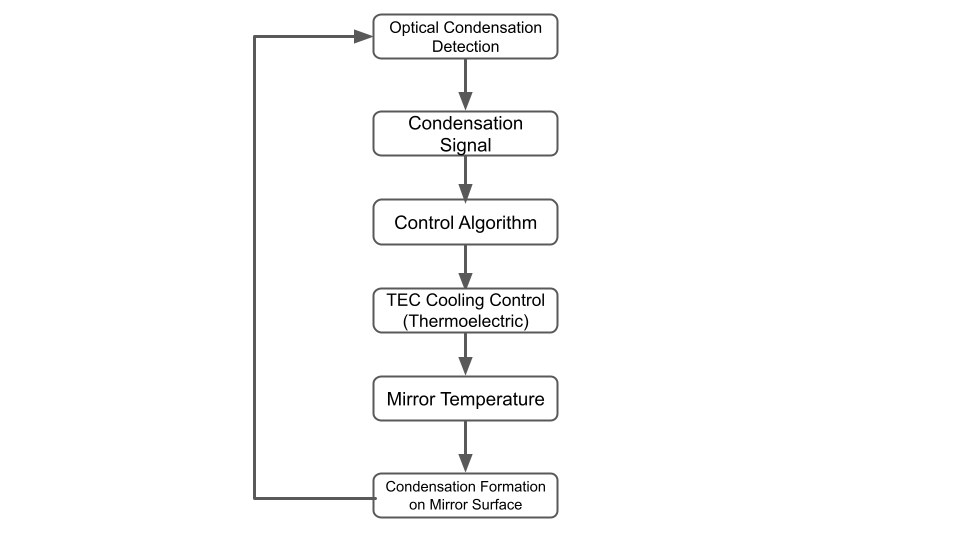
Dynamic stabilization control provides an alternative approach that does not require external humidification. Instead of inducing large temperature oscillations, the cooling power is gradually reduced as the mirror approaches the condensation region.
This approach allows the mirror temperature to converge smoothly toward the equilibrium dew point while allowing sufficient time for natural condensation layer formation. Advantages include reduced overshoot, smaller oscillation amplitude, faster stabilization, and improved repeatability.
Figure 2. Closed-loop dynamic stabilization control of the chilled mirror temperature.
6 Comparison of Stabilization Behavior
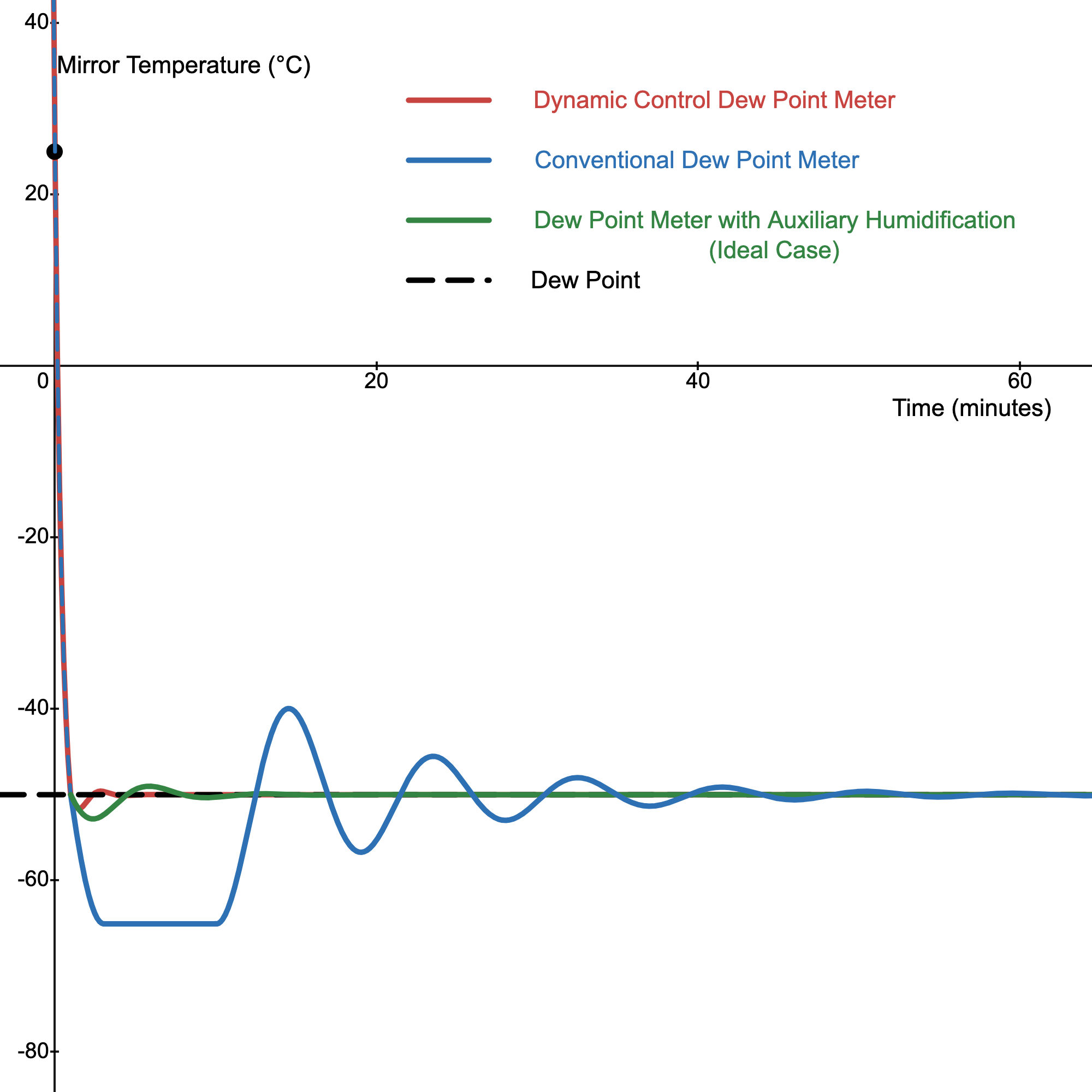
Three representative stabilization behaviors can be observed in chilled mirror dew point measurements:
Conventional oscillation control: strong mirror overcooling, repeated oscillations around the dew point, and extended stabilization time.
Auxiliary humidification control: accelerated condensation formation, but behavior dependent on humidification conditions and potential variability during continuous measurements.
Dynamic stabilization control: smooth convergence toward equilibrium, minimal overshoot, and shorter stabilization time.
These behaviors can be illustrated through mirror temperature versus time diagrams inserted as figures.
Figure 3.Typical mirror temperature stabilization behavior for three control strategies.
7 Measurement Stability and Uncertainty
Measurement stability in chilled mirror hygrometry is closely related to the stability of condensation equilibrium on the mirror surface [1,3]. Large temperature oscillations may introduce additional uncertainty sources including delayed equilibrium establishment, deviation from the true dew point, and instability in optical condensation detection.
When auxiliary humidification systems are used, additional variability may arise from variation in humidification trigger temperature, variability in introduced moisture quantity, and depletion of moisture reservoirs during continuous measurements.
Dynamic stabilization control reduces these effects by minimizing overshoot and allowing condensation equilibrium to form more gradually.
8 Conclusion
Ultra-dry gas dew point measurements present unique challenges due to extremely slow condensation kinetics. Traditional oscillatory control methods may produce large temperature fluctuations and long stabilization times. Auxiliary humidification approaches can accelerate condensation formation but introduce additional uncertainty sources.
Dynamic stabilization control allows smooth convergence toward equilibrium without external humidification, improving stabilization performance and measurement repeatability.
References
[1] Wexler, A. Vapor Pressure Formulation for Water.
[2] Hardy, B. ITS-90 Formulations for Vapor Pressure and Dew Point.
[3] Greenspan, L. Humidity Fixed Points of Binary Saturated Solutions.
[4] Sonntag, D. Physical Constants of Water Substance for Meteorology.
[5] National Physical Laboratory (NPL), Guide to the Measurement of Humidity.
Author Biography
Xiao Zhang is the founder and chief engineer of Reshining Instruments LLC in Texas, USA. He has worked on chilled mirror dew point measurement technology for more than two decades, focusing on stabilization dynamics, ultra-dry gas measurements, and humidity measurement in electrical insulation gases.