Auxiliary Humidification and Its Uncertainty in Chilled Mirror Dew Point Hygrometers
Xiao Zhang
Reshining Instruments LLC, Texas, USA
Abstract
In chilled mirror dew point hygrometers measuring ultra‑dry gases, condensation nucleation on the mirror surface can be slow, leading to long stabilization times. Some instruments introduce auxiliary humidification to accelerate condensation formation. While this technique may reduce stabilization time, it can also introduce additional uncertainty depending on trigger timing and the condition of the humidification reservoir. This paper conceptually analyzes stabilization behaviors under different humidification trigger conditions and discusses how auxiliary humidification may influence measurement stability, particularly for dew points below approximately −40 °C.
1. Introduction
Chilled mirror dew point hygrometers are widely recognized as primary instruments for humidity measurement because the measurement is based on direct thermodynamic equilibrium between the mirror surface and water vapor in the gas. The mirror temperature at which condensation and evaporation are balanced represents the true dew point temperature.
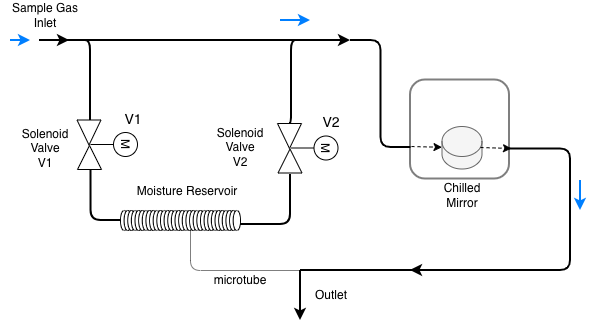
In very dry gases, however, condensation nucleation may become slow. The mirror may need to be cooled well below the equilibrium point before stable condensation appears, resulting in long stabilization times. To accelerate this process, some instruments employ auxiliary humidification, temporarily increasing the local water vapor concentration near the mirror surface. A conceptual configuration of such a system is illustrated in Figure 1.
2. Auxiliary Humidification Mechanism
In auxiliary humidification systems, a small amount of moisture is injected into the measurement gas stream through a humidification tube or reservoir when the mirror temperature reaches a predefined trigger point. The temporary increase in water vapor concentration promotes condensation nucleation on the mirror surface.
Because the injected moisture is rapidly diluted by the flowing dry gas, this effect is transient. After the humidification pulse, the system returns to the original gas condition and continues cooling toward the true dew point equilibrium.
3. Trigger Position and Stabilization Behavior
For analysis purposes, the relative position between the humidification trigger temperature and the true dew point can be expressed as:
ΔT = T_trigger − T_dp
where T_trigger represents the humidification trigger temperature and T_dp represents the true dew point temperature.
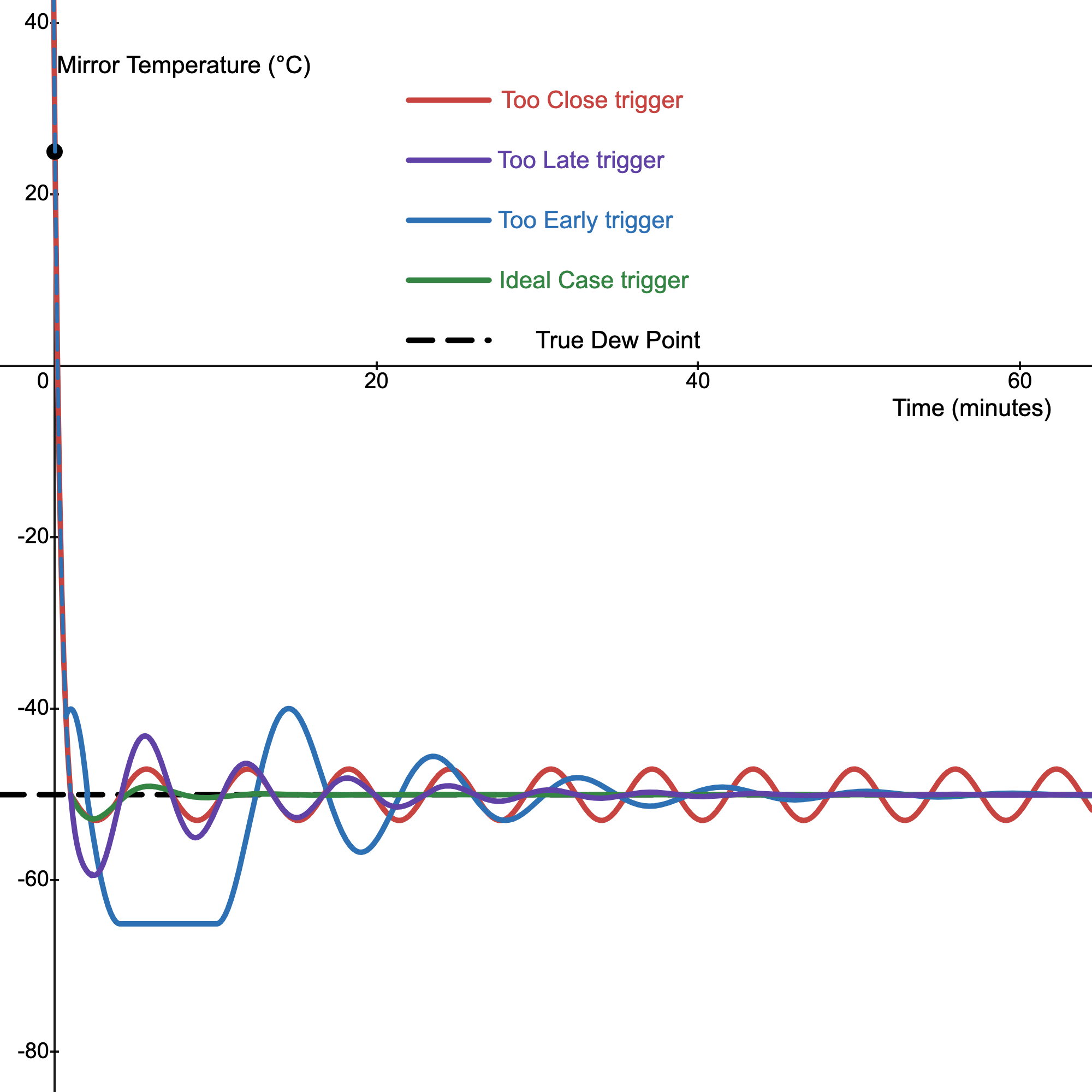
The stabilization behavior of the instrument depends strongly on this temperature difference. Conceptually, three trigger regions may be considered:
• ΔT > ~8 °C – humidification occurs too early and has little influence on condensation nucleation.
• 2 °C < ΔT ≤ 8 °C – humidification may assist condensation formation and accelerate stabilization.
• |ΔT| ≤ ~2 °C – the system becomes highly sensitive and repeated humidification cycles may disturb condensation equilibrium, producing oscillatory stabilization behavior.
Conceptual stabilization trajectories corresponding to these conditions are illustrated in Figure 2.
4. Humidification‑Related Uncertainty
Auxiliary humidification introduces several potential sources of uncertainty. These include trigger temperature settings, the quantity of injected moisture, and the moisture condition of the humidification reservoir or tube. Because the moisture reservoir may change with time and previous measurements, the magnitude of each humidification event may vary.
In ultra‑dry gases, particularly below approximately −40 °C dew point, these variations may produce noticeably different stabilization trajectories even when the true dew point of the gas remains unchanged.
5. Discussion
It should be emphasized that auxiliary humidification does not change the true dew point of the gas. Instead, it temporarily modifies the local humidity field near the mirror surface and therefore influences the dynamic stabilization trajectory of the measurement system.
As a result, auxiliary humidification may improve stabilization speed in some situations but may also introduce dynamic disturbances or oscillatory control behavior in others. The final stabilization path therefore depends both on trigger timing and on the condition of the humidification system.
6. Conclusion
Auxiliary humidification can accelerate condensation formation in chilled mirror dew point hygrometers operating under ultra‑dry gas conditions. However, the technique may also introduce additional stabilization variability depending on trigger timing and humidification reservoir conditions. Conceptual analysis shows that oscillatory stabilization may occur when humidification is triggered too close to the true dew point. These effects become increasingly significant for measurements below approximately −40 °C dew point.
Figures
Figure 1. Conceptual schematic of an auxiliary humidification system in a chilled mirror dew point hygrometer showing the sample gas flow path, solenoid valves, and humidification tube.
Figure 2. Conceptual stabilization trajectories under different humidification trigger conditions. The dashed line represents the true dew point temperature. Depending on the relative position between the humidification trigger temperature and the dew point, stabilization may occur rapidly (ideal case), exhibit oscillatory behavior when the trigger occurs too close to the dew point, or show larger transient disturbances when the trigger occurs too early or too late. The curves are schematic illustrations.